On a recent business trip to Washington, D.C., earlier this month (3 December 2025), my company had a team outing at the Smithsonian’s National Portrait Gallery. It was only by chance that I stumbled upon original oil portraits of Eisenhower, Patton, Marshall, Nimitz, and Halsey.
Although I didn’t have one of my Nikons, I tried to get decent shots with the limited capability of my iPhone. Due to challenging lighting conditions and no tripod, I had to crop and ‘square’ the majestic old frames (for the photographs you see here) due to warping over the years. Each painting carries the unique touch of its artist and era.
Dwight D. Eisenhower by Thomas Edgar Stephens (1960)
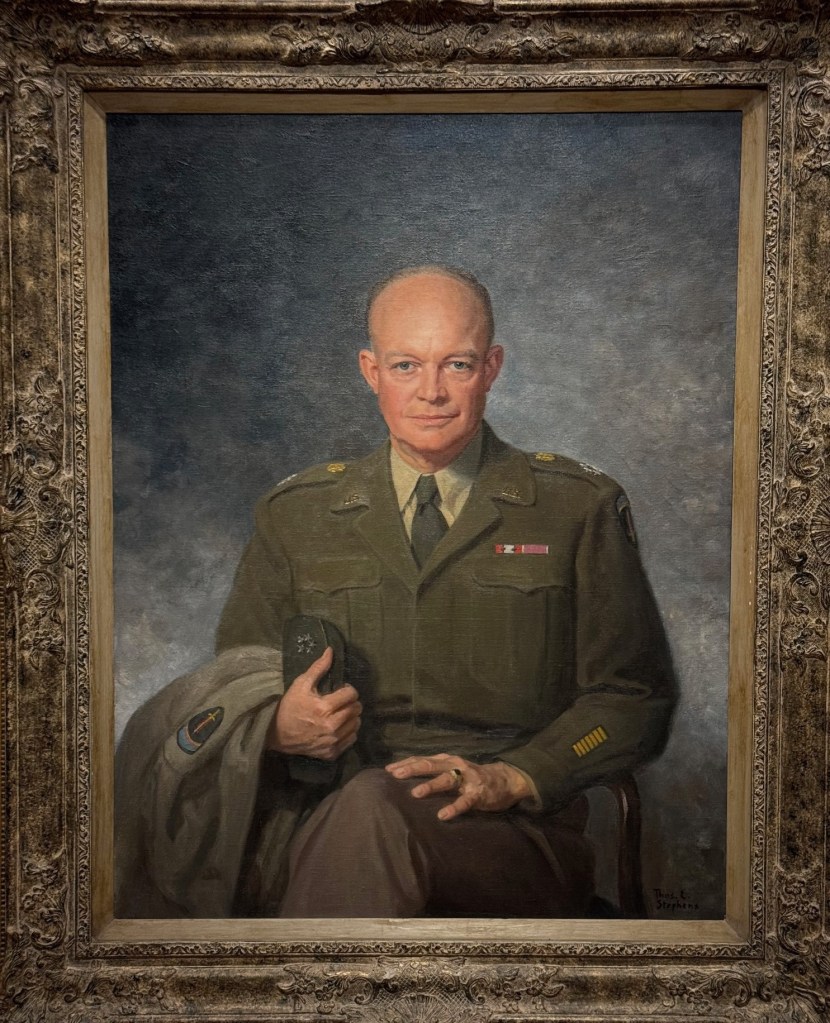
Exhibition Label: “With a talent for military strategy and the ability to work effectively with personalities of all types, General Dwight D. Eisenhower proved uniquely suited for the role of supreme commander during World War II. A career army officer, Eisenhower began his wartime service in 1941 as head of the War Plans Division under General George C. Marshall. He was assigned to lead U.S. forces in Britain in the spring of 1942 and later commanded the Allied forces’ invasions of North Africa, Sicily, and Italy (1942–43). Named supreme commander of the Allied Expeditionary Force by President Franklin Roosevelt in December 1943, Eisenhower masterminded the invasion of Normandy on June 6, 1944, and directed Allied operations in Europe until the surrender of Germany in May 1945. Enormously popular with the American public after the war, Eisenhower was elected to the presidency in 1952 and served two terms.”
George S. Patton by Boleslaw Jan Czedekowski (1945)
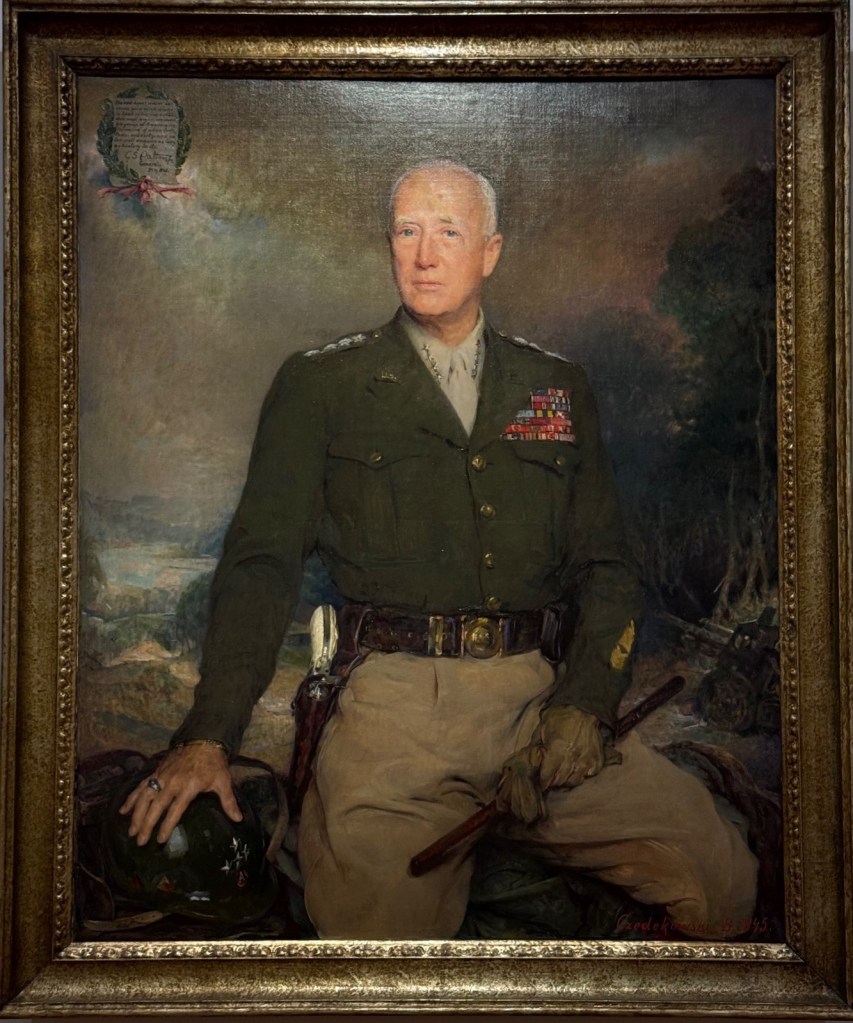
Exhibition Label: “Nicknamed “Old Blood and Guts,” General George Patton Jr. had a penchant for harsh, bluntly spoken opinions that sometimes made him the object of controversy during World War II. There was, however, no debating his soldiering abilities. In the Allied drive against Axis armies in North Africa, his gift for instilling frontline discipline was critical in shaping unseasoned American soldiers into effective fighting units. His leadership proved crucial again in the invasion of Sicily, but his finest moment came during the massive German counteroffensive in northern Europe’s Ardennes region in 1944–45. His part in repelling the Germans there placed beyond challenge his reputation as one of the most brilliant field commanders of the war. The inscription in the portrait’s upper left corner was from Patton’s declaration of May 9, 1945, telling his soldiers what an honor it had been to lead them.”
George C. Marshall by Thomas Edgar Stephens (1950)
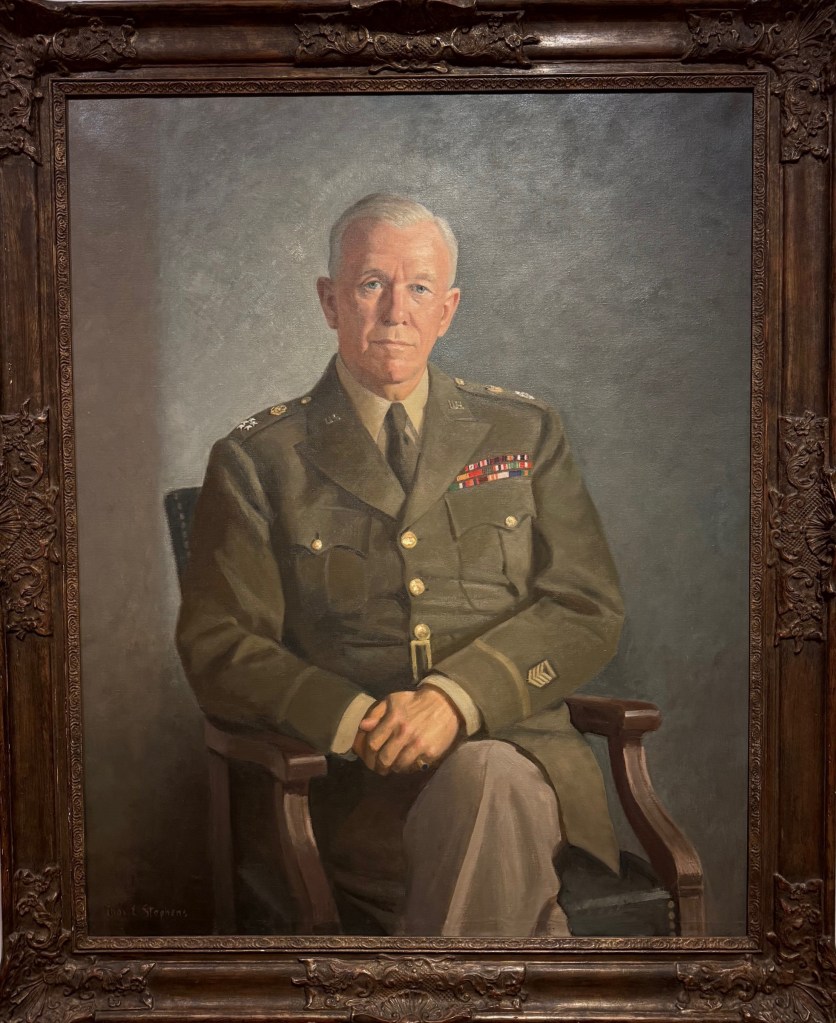
Exhibition Label: “George C. Marshall was, according to one expert observer, the “perfect” soldier. Endowed with a quick mind, a good memory, and a superb sense of strategy, he did not particularly relish war. Yet as chief of staff during World War II, he proved to be a masterful orchestrator of military mobilization. In 1945 President Harry Truman remarked that millions of Americans had served the country well in that conflict, but it had been Marshall who “gave it victory.” As capable in peace as in wartime, Marshall later became Truman’s secretary of state, and it was he who unveiled in 1947 the American aid program for rebuilding Europe’s war-ravaged economies. Ultimately named the Marshall Plan, this venture became one of the greatest triumphs in the entire history of American diplomacy.”
Chester W. Nimitz by Charles J. Fox (1945)

Exhibition Label: “In the first months after Japan’s attack on Pearl Harbor on December 7, 1941, and American entry into World War II, the Japanese push to dominate the Asian Pacific seemed unstoppable. As commander of the Pacific Fleet, Admiral Chester Nimitz was charged with halting that drive and halt it he did. Under his orchestration, American naval forces turned back the Japanese at the Battle of the Coral Sea in May 1942, and during the Battle of Midway that June, they dealt a blow from which Japan’s navy never recovered. By war’s end, Nimitz was one of the most respected leaders of the Allied cause. It is thought that the backdrop in Nimitz’s portrait is the wreckage left by the Japanese at Pearl Harbor. The picture thus marked the moment when Nimitz took command of the effort to come back from that devastating disaster.”
William F. Halsey by Douglas Chandor (1947)
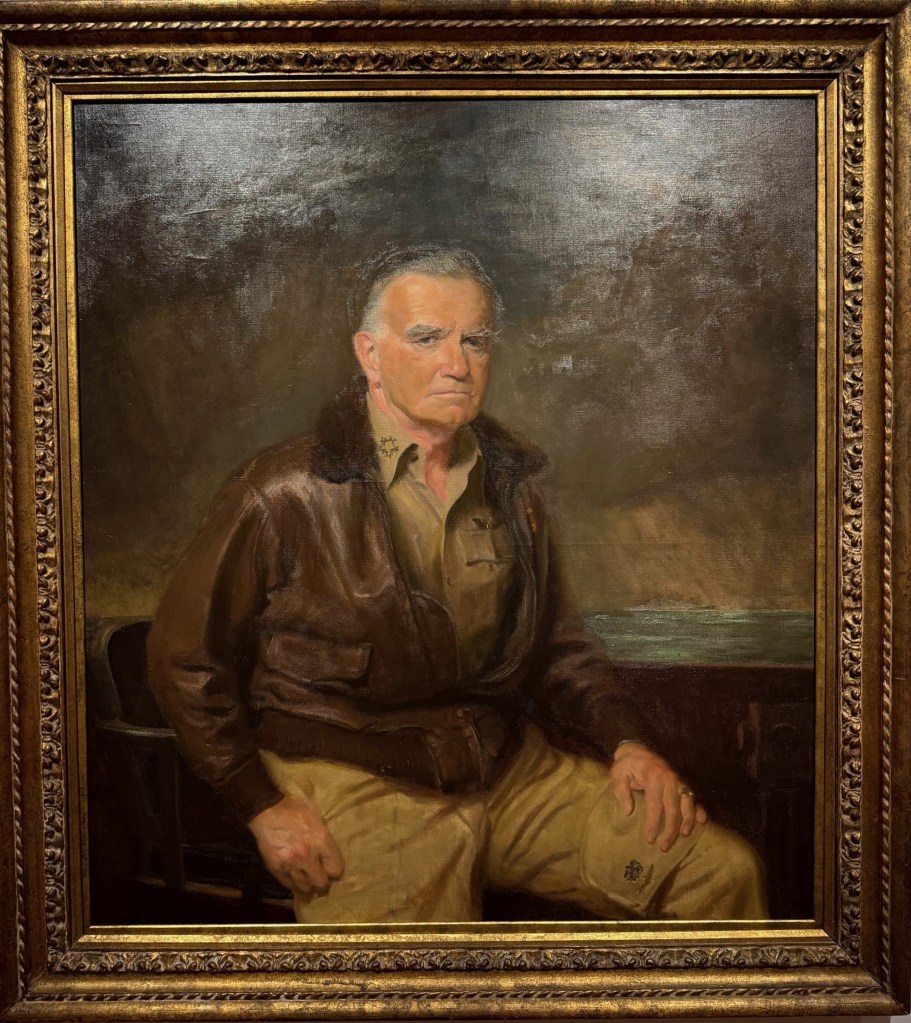
Exhibition Label: “William F. Halsey was commander of the Pacific Fleet carriers and their air group when the Japanese bombed Pearl Harbor on December 7, 1941. Soon after, he was appointed Commander of the South Pacific Force. In that role, he became a chief architect of such victories as the seizure of Guadalcanal and the Battles of Leyte Gulf and Luzon in the Philippines. He received criticism for what some perceived as his improvisational tactics and his willingness to sacrifice American lives and equipment to achieve victory. Despite this, many sailors and members of the public revered him. In his portraits of the officers and enlisted men who won the war at sea, Navy combat artist Albert K. Murray aimed to represent on canvas what he called ‘the trained and disciplined leadership that would prove to American mothers and fathers that their loved ones had not just been cannon fodder.’”
 The War Historian's Journal
Leave a comment